

Contents
- 1 What is a 10 MW Liquid Cooled AI Data Center?
- 2 Why AI Workloads Need Advanced Cooling Solutions
- 3 Key Features of a 10 MW Liquid Cooled AI Data Center
- 4 Benefits of Liquid Cooling in AI Data Centers
- 5 Types of Liquid Cooling Technologies
- 6 Role of 10 MW AI Data Centers in Modern Industries
- 7 Energy Efficiency and Sustainability
- 8 Challenges in Building Liquid Cooled AI Data Centers
- 9 Future of Liquid Cooled AI Data Centers
- 10 Conclusion
Artificial intelligence is transforming industries at an unprecedented pace. From healthcare and finance to manufacturing and autonomous systems, businesses now rely on high-performance computing to process massive datasets. As AI models become larger and more complex, traditional cooling systems often struggle to manage the heat generated by GPU-intensive workloads. This challenge has increased the demand for advanced liquid-cooled infrastructure in modern data centers.
A 10 MW Liquid Cooled AI Data Center is designed to support high-density computing environments with greater energy efficiency. According to industry reports, liquid cooling can reduce energy consumption by up to 40% compared to conventional air cooling systems. Moreover, AI-driven applications require faster processing speeds, lower latency, and scalable infrastructure, making liquid-cooled facilities a preferred choice for enterprises and cloud providers worldwide.
In this blog, we will discuss the importance of a 10 MW Liquid Cooled AI Data Center for Advanced AI Workloads. We will also explore its features, benefits, cooling technologies, energy efficiency, scalability, and future role in AI infrastructure development.
What is a 10 MW Liquid Cooled AI Data Center?
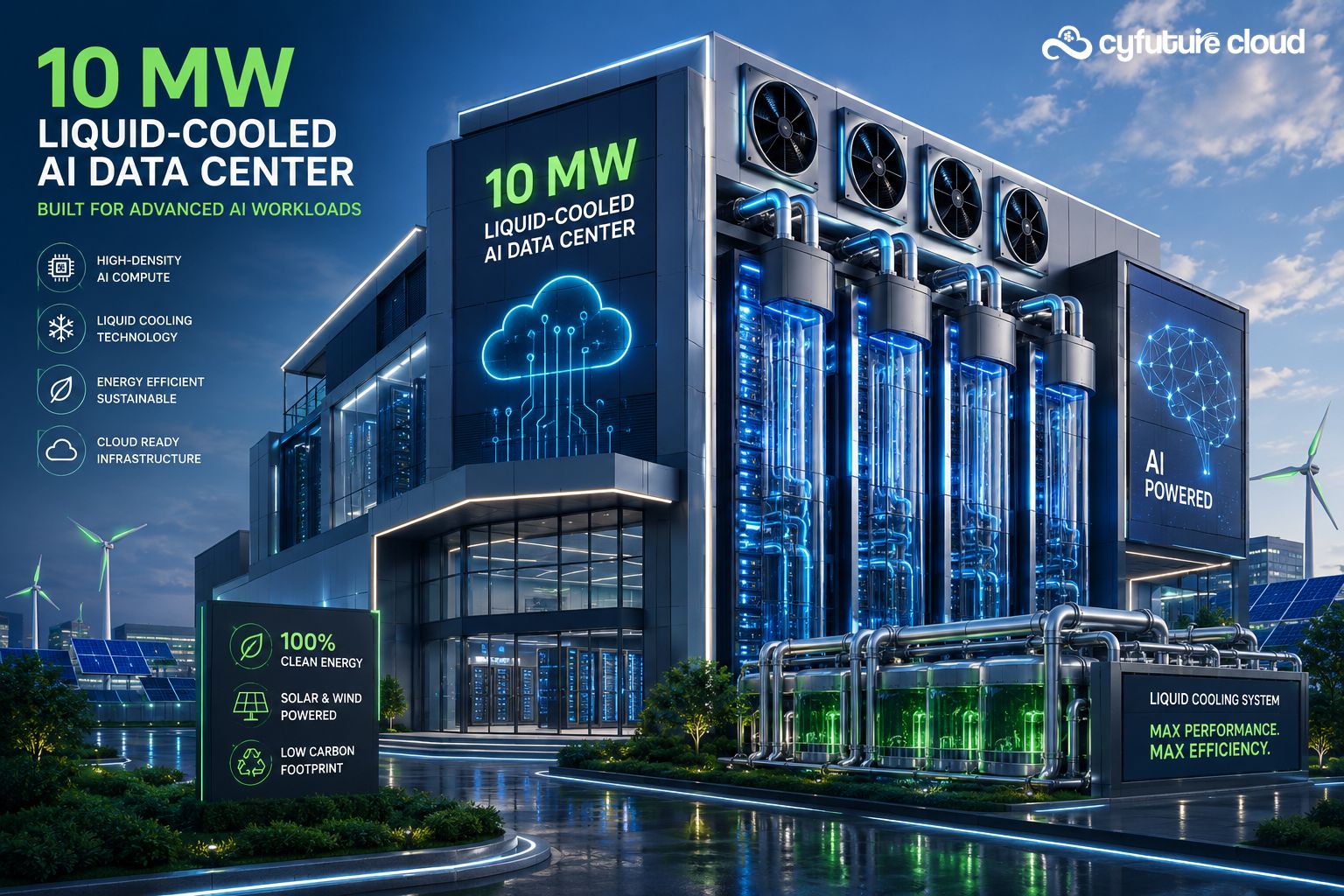
A 10 MW Liquid Cooled AI Data Center is a high-capacity facility specifically designed to support artificial intelligence and high-performance computing workloads. The term “10 MW” refers to the total power capacity available for servers, GPUs, storage systems, and networking equipment.
Unlike traditional data centers that rely on air cooling, liquid-cooled facilities use specialized liquids to absorb and transfer heat away from hardware components. As a result, these systems maintain optimal operating temperatures even during intensive AI training and inference tasks.
Moreover, liquid cooling enables higher rack density. This means organizations can deploy more GPUs and processors in less physical space while maintaining system stability and efficiency.
Why AI Workloads Need Advanced Cooling Solutions
AI workloads consume enormous computing power. Large language models, machine learning algorithms, and deep learning applications require clusters of GPUs operating continuously for long periods.
High Heat Generation
Modern GPUs generate significant heat during AI model training. Traditional cooling systems often fail to remove heat efficiently in high-density environments. Consequently, overheating can reduce hardware performance and lifespan.
Increasing Power Density
AI servers can exceed power densities of 30 kW to 100 kW per rack. In comparison, standard enterprise racks usually consume much lower power. Therefore, advanced cooling becomes essential for maintaining operational reliability.
Energy Efficiency Demands
Businesses are also focusing on sustainability goals. Liquid cooling helps reduce cooling-related power usage, which lowers overall energy consumption and operational costs.
Key Features of a 10 MW Liquid Cooled AI Data Center
Advanced Liquid Cooling Technology
The most important feature is the use of liquid cooling systems. These systems may include direct-to-chip cooling, immersion cooling, or rear-door heat exchangers. Each method improves thermal management significantly.
High-Density GPU Infrastructure
A 10 MW Liquid Cooled AI Data Center for Advanced AI Workloads supports large-scale GPU clusters. This infrastructure enables faster AI model training and real-time analytics.
Scalable Design
Scalability is another major advantage. Organizations can expand server capacity without redesigning the entire cooling infrastructure.
Redundant Power Systems
These facilities include backup power systems, UPS units, and generators to ensure continuous operation during outages.
Enhanced Network Connectivity
AI applications require low-latency networking. Therefore, modern AI data centers include high-speed interconnects and optimized networking solutions.
Benefits of Liquid Cooling in AI Data Centers
Improved Energy Efficiency
Liquid cooling transfers heat more effectively than air. As a result, cooling systems consume less electricity. This improves Power Usage Effectiveness (PUE) and reduces operating costs.
Better Hardware Performance
Lower temperatures help GPUs and CPUs operate at peak performance levels. Consequently, AI training tasks can be completed faster.
Reduced Space Requirements
Liquid-cooled racks support higher computing density. Therefore, businesses can deploy more hardware in smaller spaces.
Lower Noise Levels
Traditional air-cooling systems require powerful fans. However, liquid cooling reduces fan dependency, creating quieter environments.
Sustainability Advantages
Many companies are adopting green data center practices. Liquid cooling supports sustainability goals by lowering carbon emissions and energy consumption.
Types of Liquid Cooling Technologies
Direct-to-Chip Cooling
In this method, coolant flows directly to components like CPUs and GPUs. It efficiently removes heat from the hottest areas of the server.
Immersion Cooling
Immersion cooling involves placing hardware inside non-conductive cooling liquid. This method provides exceptional heat dissipation and energy efficiency.
Rear-Door Heat Exchangers
These systems attach to server racks and remove heat before it enters the data center environment.
Each cooling technology offers unique advantages depending on workload requirements and infrastructure design.
Role of 10 MW AI Data Centers in Modern Industries
Healthcare
AI-powered healthcare systems require fast data processing for diagnostics, medical imaging, and research. Liquid-cooled AI data centers provide the computing power needed for these applications.
Financial Services
Banks and financial institutions use AI for fraud detection, risk analysis, and algorithmic trading. High-performance infrastructure supports real-time processing and analytics.
Manufacturing
Manufacturers use AI-driven automation and predictive maintenance systems. Consequently, advanced AI infrastructure improves productivity and operational efficiency.
Autonomous Vehicles
Self-driving technologies rely heavily on AI model training and simulations. Therefore, powerful GPU infrastructure is critical for development.
Energy Efficiency and Sustainability
Energy efficiency is one of the biggest concerns in modern data center operations. Cooling systems can account for a large portion of total energy consumption.
A 10 MW Liquid Cooled AI Data Center for Advanced AI Workloads reduces energy waste by improving thermal efficiency. Moreover, many facilities integrate renewable energy sources such as solar and wind power.
Additionally, advanced monitoring systems optimize cooling performance in real time. This helps operators reduce energy usage while maintaining optimal system performance.
As governments and enterprises focus on carbon reduction targets, sustainable AI infrastructure will become increasingly important.
Challenges in Building Liquid Cooled AI Data Centers
High Initial Investment
Liquid cooling infrastructure requires significant upfront investment. Specialized equipment and advanced engineering increase deployment costs.
Maintenance Complexity
These systems require skilled professionals for installation and maintenance. Therefore, organizations must invest in technical expertise.
Infrastructure Planning
Proper planning is essential for power distribution, cooling pipelines, and system redundancy. Without careful design, operational risks may increase.
However, despite these challenges, the long-term benefits often outweigh the initial costs.
Future of Liquid Cooled AI Data Centers
The future of AI infrastructure depends heavily on efficient cooling technologies. As AI models continue to grow larger, computing demands will rise significantly.
Industry experts predict that liquid cooling will become the standard for next-generation data centers. Moreover, hyperscale cloud providers and enterprises are already investing in advanced AI-ready facilities.
Emerging technologies such as edge AI, quantum computing, and generative AI will further increase the need for scalable, energy-efficient infrastructure. Therefore, 10 MW liquid-cooled facilities will play a critical role in supporting future innovation.
Conclusion
A 10 MW Liquid Cooled AI Data Center for Advanced AI Workloads provides the power, scalability, and efficiency required for modern AI applications. With growing demand for GPU-intensive computing, traditional cooling systems are no longer sufficient.
Liquid cooling improves thermal management, reduces energy consumption, and supports high-density computing environments. Additionally, it enables organizations to achieve better performance while supporting sustainability goals.
As AI adoption continues to expand across industries, advanced liquid-cooled data centers will become essential for future-ready digital infrastructure. Businesses investing in these technologies today will gain a competitive advantage in the rapidly evolving AI landscape.